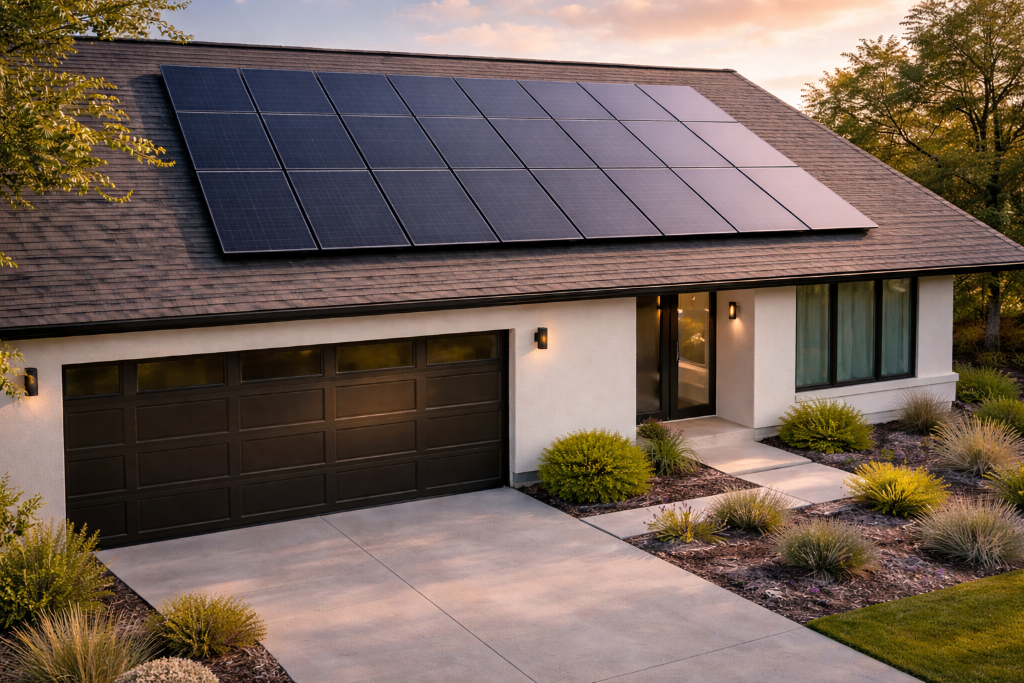
The Photovoltaic Effect
Solar panels generate electricity through a process known as the photovoltaic (PV) effect. When photons from sunlight strike the silicon cells within a solar panel, they transfer energy to electrons, causing those electrons to break free from their atomic bonds. This movement of electrons creates a direct electrical current (DC) that flows through the cell and out through conductive wiring.
This process requires no moving parts, no combustion, and no fuel — only sunlight. Each photovoltaic cell operates silently and continuously whenever exposed to solar radiation.
From Direct Current to Usable Electricity
The DC electricity produced by solar panels must be converted to alternating current (AC) before it can power the appliances and systems in your home. This conversion is performed by an inverter — a critical component of every solar installation. Modern string inverters or microinverters handle this conversion efficiently, and some systems integrate inverter functionality directly into the battery storage unit.
How Your Home Uses Solar Energy
Once converted to AC electricity, solar power flows directly into your home's electrical system and is consumed by whatever loads are active at that moment — lighting, HVAC, appliances, and electronics. When solar production exceeds your home's instantaneous demand, the excess electricity is either:
- Exported to the grid in exchange for net metering credits on your utility bill, or
- Stored in a home battery for use during nighttime hours or grid outages.
When solar production is insufficient — at night or during overcast conditions — your home draws power from the grid or from a battery as it would in any grid-connected configuration.
Panel Performance Factors
A solar panel's electricity output is influenced by several environmental and installation variables:
- Solar irradiance: The intensity of sunlight reaching the panel surface. The Rio Grande Valley ranks among the highest-irradiance regions in the United States, making it exceptionally well-suited for solar generation.
- Panel orientation and tilt: South-facing panels at an optimal tilt angle maximize annual energy capture.
- Temperature: Photovoltaic panels are most efficient at moderate temperatures. High ambient temperatures, common in Texas summers, can modestly reduce peak output, though this effect is accounted for in professional system design.
- Shading: Any obstruction that reduces direct sunlight reaching a panel will proportionally reduce its output.
System Longevity
High-quality solar panels are engineered for a service life exceeding 25 years and are backed by manufacturer performance warranties guaranteeing a minimum output level — typically 80–90% of rated capacity — over that period. With no moving parts or consumable components, solar panel systems require minimal maintenance and deliver consistent performance over their operational lifetime.