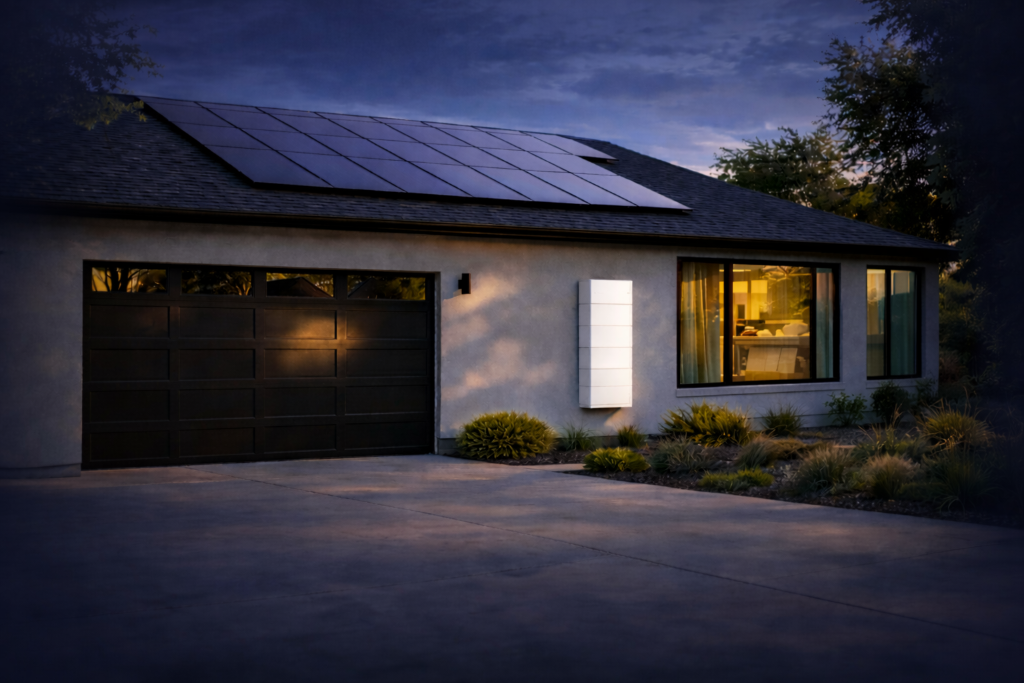
Why Home Battery Storage Matters in Texas
Texas has experienced significant grid disruptions in recent years, from the catastrophic failures during Winter Storm Uri in 2021 to repeated summer demand emergencies that have pushed ERCOT to its operational limits. For homeowners across the state — particularly in the Rio Grande Valley — home battery storage has become an increasingly practical solution for managing energy reliability and cost.
How Home Battery Systems Operate
A home battery stores electricity generated by your solar panels during daylight hours and delivers it on demand — at night, during peak rate periods, or when the grid experiences an outage. When the utility grid fails, a properly installed battery system detects the disruption and switches to backup mode automatically, typically within milliseconds. Essential loads including air conditioning, refrigeration, lighting, and medical equipment remain operational without any manual intervention.
Key Specifications to Evaluate
When comparing home battery systems, several technical specifications determine performance:
- Usable capacity (kWh): The total amount of energy the battery can store and deliver. A standard central air conditioning system draws 3–5 kW; capacity requirements scale with the number and type of loads you need to support.
- Continuous power output (kW): The maximum rate at which the battery can deliver electricity. Higher output supports simultaneous operation of multiple high-draw appliances.
- Backup coverage: Systems can be configured to support selected critical circuits or whole-home backup depending on capacity and homeowner preference.
- Solar integration: The most effective configurations pair battery storage with solar panels, allowing the battery to recharge during daylight hours for extended or indefinite backup capability.
- Warranty terms: Most quality systems include a 10-year manufacturer warranty covering performance degradation to a specified threshold.
Determining the Right Battery Capacity
System sizing depends on your home's energy consumption patterns and the loads you need to support during an outage. A single battery with adequate usable capacity can typically power essential loads — air conditioning at reduced settings, refrigeration, lighting, and device charging — for 8 to 12 or more hours. Homes requiring multi-day coverage or whole-home backup at full capacity may benefit from stacking multiple units.
When paired with solar, the battery recharges each day the sun is shining, providing effectively continuous backup even during extended grid outages.
The Case for Solar and Battery Together
Solar panels and home batteries each have limitations when deployed independently. Solar-only systems are required by code to shut down during grid outages for the safety of utility workers. Battery-only systems have finite capacity and will eventually deplete without a recharge source. Together, they create a self-sustaining energy system: solar generates power during daylight, the battery stores excess capacity, and your home remains powered through the night and during any grid disruption.
Financing Your Battery System
Home battery storage is available through $0-down financing for qualified homeowners, often bundled with a solar installation as a single loan. Monthly payments are structured to be offset by electricity bill savings, making the net financial impact manageable from the first month of system operation.
Battery Storage in Your City
Solergy installs home battery storage across the Rio Grande Valley. Learn more for your specific area: